You’ve probably experimented with ChatGPT or similar AI tools by now. They’re impressive for general questions, but ask them about your company’s pricing, internal processes, or last quarter’s sales data and they draw a blank. These models only know what they were trained on, not what matters most to your business.
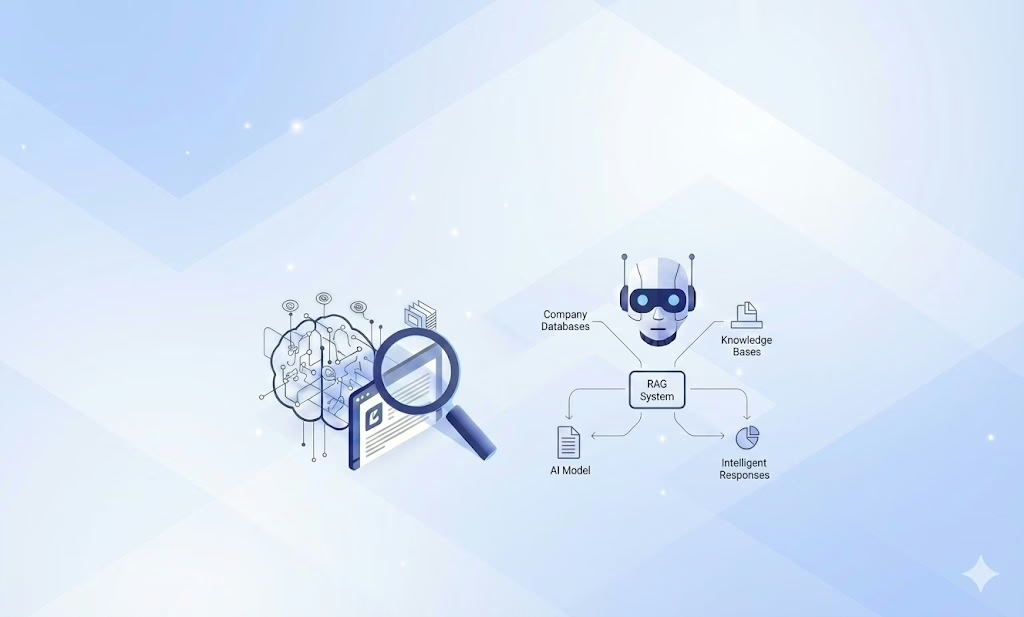
This is where RAG systems change the game. Retrieval-Augmented Generation connects AI models to your actual company data: documents, databases, and knowledge bases. The result is answers grounded in your specific context. Instead of generic responses, you get AI that actually understands your business.
In this guide, we’ll break down how RAG works, why it’s becoming essential for businesses adopting AI, and what it takes to implement one that delivers real value.
The Problem: AI That Doesn’t Know Your Business
Most AI assistants operate in a vacuum. They’re trained on public internet data, which makes them great for general knowledge but useless for business-specific questions.
Common frustrations include:
- Customer service bots that can’t answer product-specific questions
- Internal chatbots that don’t know your company policies or procedures
- AI tools that hallucinate information instead of admitting they don’t know
- Knowledge locked in PDFs, wikis, and databases that AI can’t access
Consider a typical scenario: your support team spends hours answering the same questions about your product configurations. You deploy a chatbot, but it gives generic answers because it has no access to your technical documentation. Customers get frustrated, and your team still handles the same tickets.
The cost isn’t just inefficiency. It’s missed opportunities. Teams can’t leverage AI for decision-making when it doesn’t understand company context. And while workflow automation tools like n8n can handle structured tasks, they can’t answer nuanced questions that require understanding your documentation. The good news is that RAG architecture solves this by bridging the gap between powerful AI models and your proprietary data.
How RAG Systems Work
RAG combines two capabilities: retrieving relevant information from your data sources and generating natural language responses based on that information. Here’s the process in plain terms.
The Three-Step Flow
1. Query Understanding
When a user asks a question, the system first converts it into a format that can be matched against your documents. This uses embedding models that understand meaning, not just keywords. So “What’s our refund policy?” matches documents about “returns and exchanges.”
2. Retrieval
The system searches your indexed knowledge base and pulls the most relevant chunks of information. This might come from PDFs, Confluence pages, database records, or any structured/unstructured data you’ve connected.
3. Generation
The retrieved context gets passed to a large language model (like GPT-4 or Claude) along with the original question. The model generates a response grounded in your actual data, with the ability to cite sources.
Why This Matters for Accuracy
Traditional chatbots rely on predefined responses or pure AI generation. RAG systems ground every answer in retrieved facts, which dramatically reduces hallucinations. When the AI doesn’t find relevant information, it can say so honestly rather than making something up.
Business value: Your team and customers get trustworthy answers. Support tickets decrease. Decision-making improves because people can query company knowledge in natural language.
Technical approach: Modern RAG implementations use vector databases (like Pinecone, Weaviate, or pgvector) to store document embeddings, with orchestration frameworks like LangChain or LlamaIndex to manage the retrieval and generation pipeline.
Real-World Applications
RAG isn’t theoretical. Businesses are already using it to solve concrete problems.
Internal Knowledge Assistant
The Challenge:
A professional services firm had years of project documentation, proposals, and case studies scattered across SharePoint and local drives. Consultants spent hours searching for relevant past work when preparing new proposals.
The Solution:
A RAG-powered assistant indexed all historical documents and allowed natural language queries like “Show me proposals we’ve done for healthcare clients involving data migration.”
The Results:
- 60% reduction in proposal preparation time
- Consistent reuse of proven approaches and language
- New hires productive faster with instant access to institutional knowledge
Customer-Facing Product Support
Companies with complex products (software platforms, industrial equipment, financial services) use RAG to power support chatbots that actually work. Instead of deflecting to “contact support,” these bots answer configuration questions, troubleshoot issues, and guide users through processes using the company’s actual documentation.
Compliance and Policy Queries
Legal and compliance teams use RAG systems to make policy documents queryable. Employees can ask “What’s our policy on vendor gifts over $100?” and get the exact policy text with source citations. No more hunting through PDFs.
Building a RAG System: What It Takes
Implementing RAG isn’t plug-and-play, but it’s also not as complex as building AI from scratch. Here’s what’s involved.
Data Preparation
Your documents need to be chunked into retrievable segments, cleaned of formatting noise, and embedded into vectors. The quality of your RAG system depends heavily on this step. Garbage in, garbage out.
Infrastructure Choices
You’ll need:
- A vector database for storing and searching embeddings
- An embedding model (OpenAI, Cohere, or open-source alternatives)
- An LLM for generation (cloud APIs or self-hosted models)
- An orchestration layer to tie it together
Ongoing Maintenance
RAG systems need to stay current. When your documentation changes, your knowledge base needs updating. This means building pipelines that sync new content and re-embed modified documents.
Key Takeaways
1. RAG bridges AI and your data. It’s the practical way to make language models useful for business-specific queries.
2. Accuracy improves dramatically. Grounding responses in retrieved documents reduces hallucinations and builds trust.
3. Implementation requires planning. Data quality, chunking strategy, and infrastructure choices all impact results.
Is RAG Right for You?
Consider RAG if you:
- Have substantial internal documentation that employees or customers need to query
- Want AI assistants that give accurate, company-specific answers
- Need to reduce repetitive questions handled by your team
- Are looking to unlock value from unstructured data (PDFs, wikis, emails)
Start simpler if you:
- Have minimal documentation to work with
- Need basic automation without natural language understanding
- Don’t have resources for initial implementation and maintenance
How Novemind Builds RAG Solutions
At Novemind, we design and implement RAG systems tailored to your specific data landscape and use cases. Our approach combines robust architecture (using tools like LangChain, vector databases, and both cloud and self-hosted LLMs) with a focus on user experience and long-term maintainability.
Whether you’re building an internal knowledge assistant, a customer-facing support bot, or a specialized tool for your industry, we work with you from data assessment through deployment and optimization.
Ready to Make Your Data Work Harder?
RAG systems turn your company’s accumulated knowledge into an accessible, queryable asset. If you’re exploring how AI can actually understand your business, not just generate generic text, let’s talk about what’s possible.
Book a free consultation to discuss your data, your use cases, and a practical path forward.
Related reading: