A 2025 U.S. Chamber of Commerce survey found that 68% of small businesses now use AI tools regularly, up sharply from 48% in mid-2024. Meanwhile, Gartner predicts 40% of enterprise applications will feature task-specific AI agents by the end of 2026, up from less than 5% in 2025. But most of the conversation around AI agents focuses on large enterprises with dedicated IT teams and substantial budgets. What about small businesses?
The good news is that AI agents have become genuinely accessible to companies of all sizes. The technology has matured, costs have dropped, and implementation paths have simplified. A PwC survey of 1,000 business leaders found that 79% of organizations have adopted AI agents to some extent. The question for small businesses is no longer “should we explore this?” but “where do we start?”
This guide cuts through the hype to show you exactly how small businesses can start using AI agents today, what they actually cost in 2026, and where they deliver the most value.
The Small Business AI Challenge
Small businesses face a unique set of constraints that make traditional automation difficult. You’re likely running lean, with team members wearing multiple hats. There’s no dedicated IT department to build and maintain complex systems. And every technology investment needs to prove its worth quickly.
Common pain points include:
- Customer inquiries piling up while your team handles other priorities
- Repetitive administrative tasks consuming hours each week
- Valuable knowledge trapped in documents, emails, and spreadsheets
- Inconsistent follow-up on leads and customer requests
- Limited capacity to scale operations without hiring
These challenges often push small businesses toward generic chatbots or basic automation tools. But these solutions frequently disappoint. Chatbots give scripted responses that frustrate customers. Simple automation breaks when processes change. The result is wasted investment and lingering skepticism about AI.
AI agents represent a fundamentally different approach. Unlike rigid automation, agents can reason through problems, access your business data, and take meaningful actions. They adapt when situations change rather than breaking. If you’re new to the concept, our overview of AI agents and their key applications provides helpful context on how they differ from traditional software.
What AI Agents Can Actually Do for Small Businesses
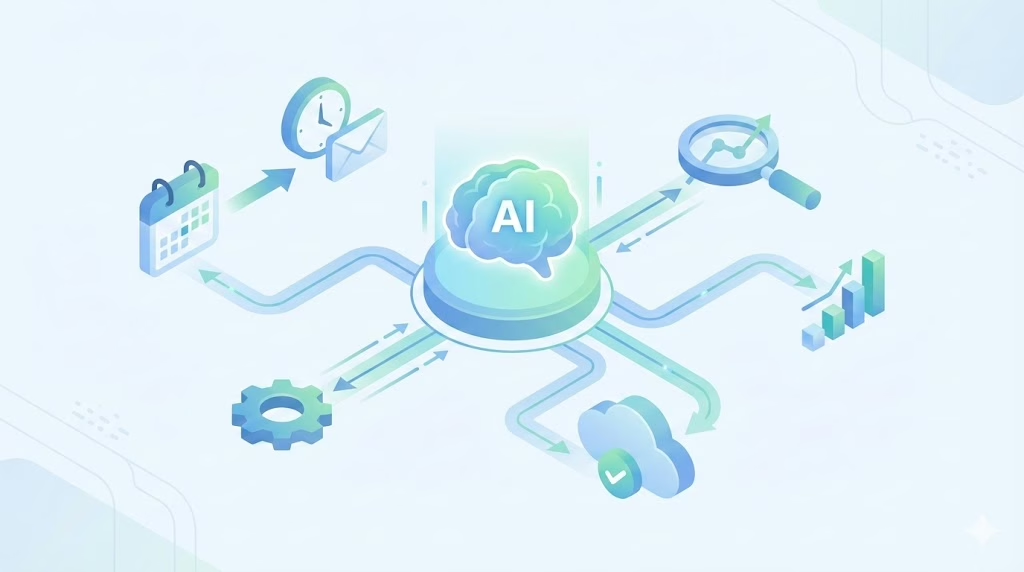
AI agents combine language understanding with the ability to use tools and access information. This makes them useful for tasks that previously required human judgment or were too complex to automate.
Customer Support That Actually Helps
An AI agent can handle customer inquiries by pulling information from your knowledge base, order system, or CRM. Instead of deflecting questions to “contact support,” it answers them. When it genuinely can’t help, it escalates intelligently with full context for your team.
Customer service is the leading AI agent use case in 2026 for good reason. Agents handling tier-one support can save small teams 40+ hours monthly. Faster response times, consistent answers, and your team focuses on complex issues rather than repetitive questions.
Administrative Task Automation
Agents excel at tasks that involve gathering information, making decisions based on rules, and taking action across multiple systems. Think invoice processing, appointment scheduling, data entry from emails, or generating reports from multiple sources.
Modern agents connect to your existing tools through APIs and integrations. Platforms like n8n can orchestrate these connections, while the AI layer handles the reasoning and decision-making that was previously impossible to automate.
Sales and Lead Management
An AI agent can qualify incoming leads, send personalized follow-ups, update your CRM, and alert your sales team when prospects are ready to talk. It works around the clock without the inconsistency of manual processes.
Organizations using AI in their CRM workflows report significant improvements in lead response times and conversion rates. No leads fall through the cracks. Your sales team spends time on conversations, not data entry.
Internal Knowledge Access
Small businesses accumulate knowledge in scattered documents, past emails, and the heads of long-term employees. An agent can make this information queryable. Ask “What was our agreement with Vendor X?” or “How did we handle the shipping issue last March?” and get answers instantly.
This is where Retrieval-Augmented Generation (RAG) technology has made the biggest impact. Your business documents become a searchable knowledge base that any team member can query in natural language.
Getting Started: A Practical Roadmap
Implementing AI agents doesn’t require a massive technology overhaul. Here’s a realistic path for small businesses.
Step 1: Identify One High-Value Use Case
Don’t try to automate everything at once. Look for tasks that are:
- Repetitive and time-consuming
- Rule-based with clear success criteria
- Currently creating bottlenecks or delays
- Involving information that’s already digital
Good starting points include customer FAQ handling, appointment booking, lead qualification, or document-based Q&A. The businesses seeing the strongest results in 2026 start with one focused use case and expand based on proven value.
Step 2: Audit Your Data and Systems
AI agents are only as good as the information they can access. Before building anything, assess:
- Where does the relevant information live?
- Is it structured (databases, CRM) or unstructured (documents, emails)?
- What systems would the agent need to connect to?
- Are there APIs or integrations available?
This audit often reveals quick wins. Sometimes organizing existing documentation is enough to enable a useful agent. It also prevents the most common implementation failure: launching an agent that can’t access the information it needs.
Step 3: Choose Your Implementation Path
Small businesses have three main options:
Off-the-shelf platforms: Tools like Intercom, Drift, or Zendesk now offer built-in AI agent capabilities. These work well for customer support use cases and require minimal technical setup. Implementation takes days to weeks, with costs typically ranging from €50 to €500 per month depending on volume and features.
Low-code agent builders: Tools like Voiceflow, Botpress, or Microsoft Copilot Studio let you build custom agents without deep technical expertise. Good for businesses with specific workflows. Expect platform costs plus 20 to 60 hours of setup time, which a technically-minded team member or consultant can often handle.
Custom development: For unique requirements or deep system integration, a custom-built agent provides the most flexibility. In 2026, low-code custom AI agents start at around €5,000 to €15,000, while more sophisticated agents with multi-step workflows and API integrations range from €20,000 to €70,000+. Timeline is typically 4 to 16 weeks depending on complexity.
The right choice depends on your specific situation. A business with straightforward customer support needs might thrive with an off-the-shelf tool. A company with unique workflows or legacy systems may need custom development to see real value.
Step 4: Start Small, Measure, Expand
Launch with a limited scope. Monitor performance closely. Common metrics to track:
- Resolution rate (issues handled without human intervention)
- Customer satisfaction scores
- Time saved per week
- Error rates and escalation frequency
- Cost per interaction compared to manual handling
Use these insights to refine the agent before expanding its responsibilities. The most successful implementations follow a 90-day measurement cycle before scaling.
Realistic Costs and ROI in 2026
Small businesses need honest numbers. The AI agent market crossed $7.6 billion in 2025 and is projected to exceed $10.9 billion in 2026, which means more options and better pricing for businesses of all sizes. Here’s what to expect:
Off-the-shelf platforms: €50 to €500/month depending on volume and features. Implementation in days to weeks. Best for standard customer support and FAQ handling.
Low-code builds: Platform costs plus 20 to 60 hours of setup time. Total investment typically €2,000 to €10,000 including configuration. Good for businesses that want customization without full development costs.
Custom development: €5,000 to €70,000+ depending on complexity, integrations, and ongoing support needs. Timeline of 4 to 16 weeks. Makes sense when off-the-shelf tools can’t support your specific data requirements, compliance needs, or workflow complexity.
Where ROI appears fastest: Customer service agents handling tier-one support typically pay for themselves within 3 to 6 months. A custom agent that deflects 50 to 60% of support tickets from a team creates clear, measurable savings almost immediately.
The important thing to budget for: ongoing costs beyond the initial build. LLM API usage, hosting, and maintenance typically add €200 to €2,000 per month depending on volume. Factor these into your business case from the start.
Key Takeaways
Start with one focused use case. Pick a task that’s clearly defined, data-accessible, and causing real pain today. Customer support FAQ handling is the most proven starting point for small businesses.
Audit before you build. Understanding your data landscape prevents wasted effort and sets realistic expectations. If your data lives in scattered, unstructured formats, address that first.
Match the solution to your situation. Off-the-shelf tools work for common use cases. Custom builds make sense for unique requirements. Don’t over-engineer your first implementation.
Measure and iterate. Track specific metrics from day one. Use data to guide expansion. The businesses getting real value from AI agents are those that approach implementation methodically rather than chasing hype.
Is Your Business Ready?
Good candidates for AI agents:
- Digital-first operations with data in accessible systems
- Customer-facing teams stretched thin on repetitive inquiries
- Businesses with documented processes that could be automated
- Companies seeing growth constrained by operational capacity
Consider waiting if:
- Core processes are still undefined or constantly changing
- Critical data exists only in paper or isolated systems
- No one on the team can own the implementation
- Budget doesn’t allow for proper setup and iteration
AI agents aren’t magic, but they are increasingly practical. The businesses seeing results are those that approach implementation methodically, starting small and expanding based on proven value. As we explored in our analysis of how AI and automation are transforming business operations, the companies that move thoughtfully now will have significant advantages as these technologies mature.
Ready to Explore AI Agents for Your Business?
At Novemind, we help small and mid-sized businesses implement AI agents that deliver measurable results. Our AI agent development team works with you from initial assessment through deployment, whether you need help identifying the right use case, building custom integrations, or developing an agent tailored to your workflows.
The best implementations start with understanding your specific challenges. Let’s discuss where AI agents could create the most value for your business.
Start the conversation and explore what’s possible when AI is designed around how your business actually works.
Related reading: