Model Context Protocol Explained: How MCP Connects AI to Your Business
21 May 2026

For most of the modern AI era, large language models lived in a sealed glass box. You could ask them anything, but they could see almost nothing. No access to your CRM, no view into your file shares, no awareness of what was happening in your project tracker an hour ago. Connecting an AI to actual business data meant writing bespoke integration code for every tool, and rewriting it every time the model or the API changed.
Model Context Protocol, almost universally called MCP, is the standard that broke that pattern. Originally introduced by Anthropic in late 2024 and now supported by every major AI vendor and a growing ecosystem of open-source servers, MCP is the layer that lets AI agents reach into your business systems in a safe, controlled, and reusable way. By 2026, it has become the default way to wire AI into a company's actual workflow.
This article is a practical introduction for business and technology leaders. We explain what MCP is, what changes when you adopt it, where it fits in the wider AI agent landscape, and how to think about MCP in the context of your own systems.
The Integration Tax That Stalled AI Adoption
Until MCP, the dominant model for putting AI to work inside a business looked roughly like this. A team picks a use case, often an internal Q&A assistant or a customer support copilot. They wire the LLM to one data source, usually through a custom retrieval pipeline. The proof of concept is impressive. Then real adoption begins.
That is where the integration tax kicks in.
- Every new data source needs its own connector, its own authentication flow, and its own permission model.
- Each connector ages quickly. APIs change. Auth methods rotate. Internal tools get replaced. Maintenance compounds.
- Switching the underlying LLM, for cost, quality, or compliance reasons, often means rewriting everything that touched a vendor-specific tool-use format.
- Different teams build similar connectors in parallel because none of the work is reusable.
The result is familiar. Promising AI projects stall somewhere between the demo and production, not because the model is too weak, but because connecting it to the rest of the business is too expensive to scale. For a deeper look at this dynamic, see our guide on building enterprise RAG systems.
MCP attacks this problem at the protocol level rather than at the application level.
What MCP Actually Is
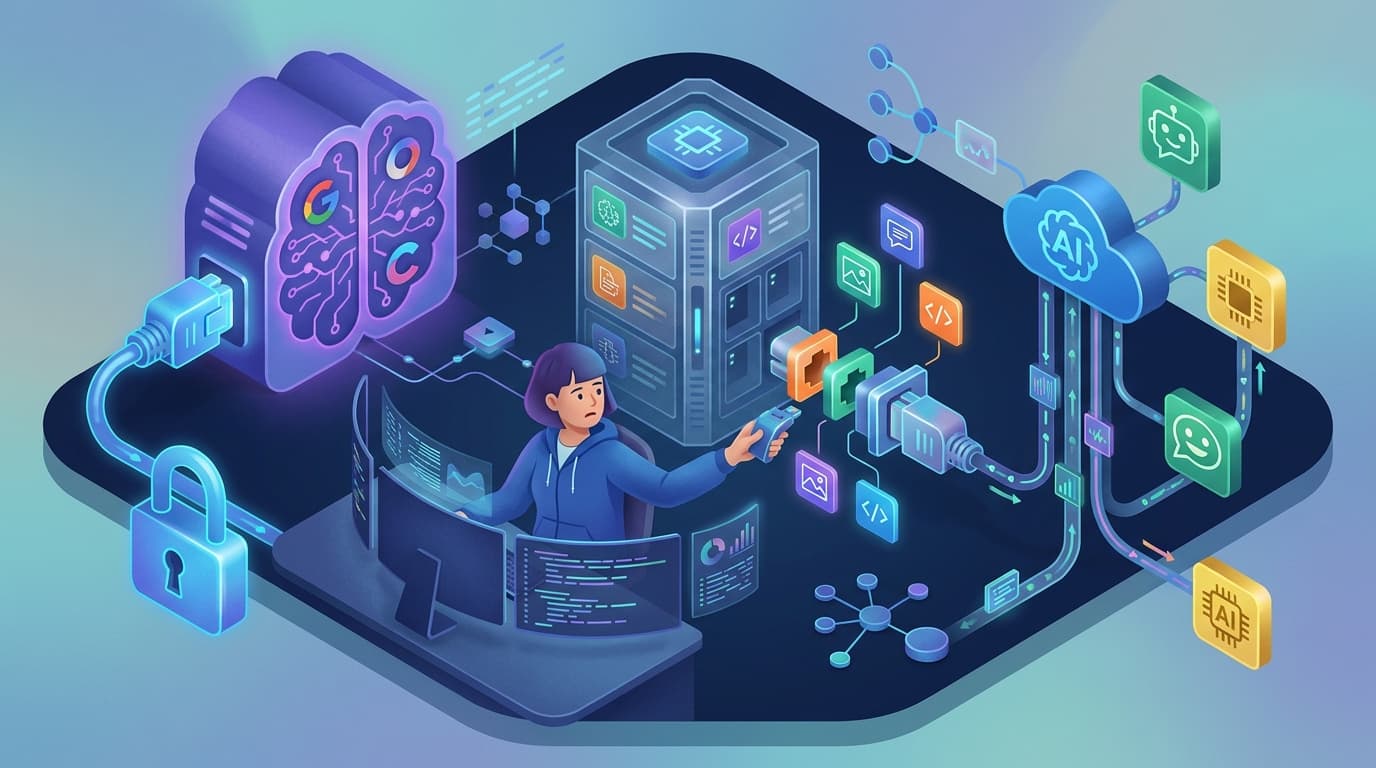
At its core, Model Context Protocol is an open specification for how AI applications talk to external tools and data sources. The mental model that fits best is the one we already use for keyboards, printers, and storage devices. USB did not make any single device better. It made every device speak the same language, so that you could plug any keyboard into any computer without writing a custom driver. MCP plays the same role for AI agents.
The protocol defines two sides.
MCP servers expose a set of capabilities. A server might offer access to your Notion workspace, your Postgres database, a Linear project, a Stripe account, a folder on Google Drive, or a custom internal API. Each server declares which tools, resources, and prompts it provides, along with the schema for using them.
MCP clients are the AI applications that consume those capabilities. Claude Desktop, Claude Code, ChatGPT, IDE assistants, internal agents, and custom AI applications all act as clients. A client connects to one or more servers, discovers what they offer, and lets the underlying model invoke their tools when needed.
Because the protocol is open and consistent, the work involved in connecting a tool to AI now happens once, on the server side, and benefits every client that supports MCP. The same Notion server can power Claude, GPT, an internal sales agent, and a customer support bot, without any of them knowing about each other.
A few properties matter for business use.
- Authentication and authorization stay with the server. Your CRM connector enforces your CRM's permission model. The AI client never sees credentials it does not need.
- Capabilities are discoverable at runtime. Agents can be told what tools exist rather than being hard coded to specific functions, which makes adding or removing data sources a configuration change rather than a code change.
- Model vendor lock-in shrinks. Because MCP standardises the tool interface, the LLM behind the agent can be swapped with far less rework. That changes the strategic conversation around choosing between Claude, GPT, and open-source LLMs.
Where MCP Fits Alongside RAG and AI Agents
MCP is not a replacement for retrieval-augmented generation, and it is not the same thing as an AI agent. It is the connective tissue between them.
Think of the AI stack in three layers.
- The model layer. Claude, GPT, Llama, Mistral, and similar systems. These provide reasoning, language understanding, and tool use.
- The orchestration layer. Agents, agent frameworks, and RAG pipelines that decide what the model should do, in what order, with what context.
- The integration layer. The connection between the orchestration layer and your actual business systems. This is where MCP lives.
RAG systems typically need to fetch documents from a knowledge base. AI agents need to query systems and take action. Both rely on the integration layer. MCP makes that layer standard, modular, and reusable. The model layer above it and the orchestration layer around it can evolve independently without breaking the way agents touch your data.
What MCP Looks Like in Practice
Three short scenarios illustrate the business value.
Internal knowledge assistant. A consultancy connects MCP servers for Notion, Google Drive, and Slack. Their internal Claude assistant can answer questions like "what did we propose to client X last quarter, and what was the engagement outcome?" by combining proposals, project docs, and the Slack thread where the team debriefed. Adding a fourth source later, say a new project management tool, means installing one more MCP server. No retraining, no rebuild.
Sales operations agent. A SaaS company exposes their CRM and email system through MCP. Their sales agent reads opportunities, drafts personalised outreach, books meetings, and updates the deal stage. Crucially, the same agent infrastructure can be pointed at a different CRM the following year. Migration becomes a server swap rather than a rewrite.
Operations and reporting. An e-commerce team connects MCP servers for Postgres, their analytics warehouse, and Linear. A daily agent pulls operational metrics, summarises anomalies, opens a Linear ticket for anything that needs human attention, and posts a digest to the operations channel. What used to be a custom internal tool becomes a small set of prompts on top of standard infrastructure.
Pattern matters more than detail in these examples. In each case, MCP turns "build a custom AI tool" into "connect existing tools to AI." That is a fundamentally different cost curve.
A Practical Adoption Path
MCP is most valuable to businesses that are already trying to put AI into the day-to-day flow of work, not those that have not yet experimented at all. If you are still scoping your first use case, the right starting point is the one we describe in our AI agents for small business guide. MCP enters the picture once you know what you want your agents to actually do.
Once that is clear, a sensible adoption path looks like this.
- Map the data sources and tools your agents need. CRM, ticketing, documents, databases, internal APIs. Rank them by business impact.
- Check the ecosystem before building. Open-source MCP servers already exist for most popular SaaS tools, databases, file systems, and cloud platforms. Reusing a vetted server is almost always cheaper than building one. Our guide to the MCP ecosystem in 2026 covers how to tell an official server from a risky one.
- Build custom servers for what is genuinely unique. Your internal billing system, your proprietary data lake, or your domain-specific workflow engine likely need bespoke servers. These are the parts of your integration stack that deserve real engineering investment.
- Standardise on security from day one. Decide which agents can call which servers, scope credentials tightly, log every tool call, and treat MCP servers as production services, not experiments.
- Revisit your model strategy. With MCP in place, switching models becomes less painful. That changes how you think about building versus buying custom AI and how aggressively you can adopt new releases.
The full cost of an MCP-based AI rollout depends heavily on how many custom servers you need and how mature your data systems already are. For most mid-sized businesses, the realistic spread is €15,000 to €80,000 for an initial deployment that covers three to six core systems, plus ongoing operational costs that look more like running another internal service than running an AI platform.
What This Means Strategically
The introduction of MCP is not just a technical detail. It changes the economics of business AI in three concrete ways.
First, it lowers the floor for what is realistic. Use cases that used to require a multi-quarter custom build can now be assembled from existing components. That makes AI projects easier to justify, easier to start, and easier to retire if they do not work.
Second, it raises the ceiling for what is sustainable. Because the integration layer is standardised, the AI footprint of a business can grow without each new agent multiplying the maintenance burden. The marginal cost of one more agent drops sharply once the underlying MCP fabric is in place.
Third, it shifts strategic risk away from any single vendor. The same servers, the same internal tooling, and the same agents can run on whichever model is the right fit for cost, latency, or compliance at any given moment. For European businesses navigating the post-Anthropic and Google enterprise AI landscape, that flexibility is worth more than any single benchmark win.
Building With MCP, Not Around It
MCP is one of those rare standards that benefits early adopters more than late ones, because the operational habits and infrastructure choices you make now will compound for years. Treating MCP as a temporary integration trick is a mistake. Treating it as the foundation of your business AI stack is what most serious teams are doing in 2026.
If your organisation is already running AI agents in production, or is about to, MCP should be near the top of your technology agenda this year. The protocol is mature, the ecosystem is healthy, and the pattern is well established. The remaining work is figuring out which systems matter most to your business, how to expose them safely, and how to design agents that use that access responsibly.
Our AI agent development team helps companies plan, build, and operate MCP-based agent architectures, from internal assistants to customer-facing systems.