The MCP Ecosystem in 2026: What It Means for Your Business
6 July 2026

Eighteen months ago, connecting an AI agent to your business tools meant hand-writing a connector for every system, then maintaining each one as APIs shifted underneath you. Today there is a public registry of thousands of ready-made connectors, a standard way to host them securely, and enterprise vendors shipping official integrations as a checkbox feature. The Model Context Protocol did not just win the standards debate. It grew an ecosystem around itself.
That shift matters because a protocol is only as useful as the tools that speak it. In 2026, MCP has crossed the threshold from promising standard to practical infrastructure. The question for business and technology leaders is no longer "should we pay attention to MCP?" It is "how do we adopt the ecosystem safely, and what should we build versus reuse?"
This article maps the MCP ecosystem as it actually stands in 2026, what has matured, what is still rough, and how a business should think about plugging into it. If you are new to the protocol itself, start with our explainer on how MCP connects AI to your business, then come back here for the ecosystem view.
From a Clever Standard to a Working Market
A year ago, the honest assessment of MCP was that the idea was excellent and the tooling was early. Servers existed, but installing one meant editing config files by hand. Security was mostly "trust the developer." Discovery meant scrolling through community lists on GitHub.
The 2026 picture is different in four concrete ways.
- There is an official registry. Instead of scattered community lists, there is now a central place to publish and discover MCP servers, with metadata about what each one does and who maintains it. Finding a vetted connector for a mainstream SaaS tool is a search, not a research project.
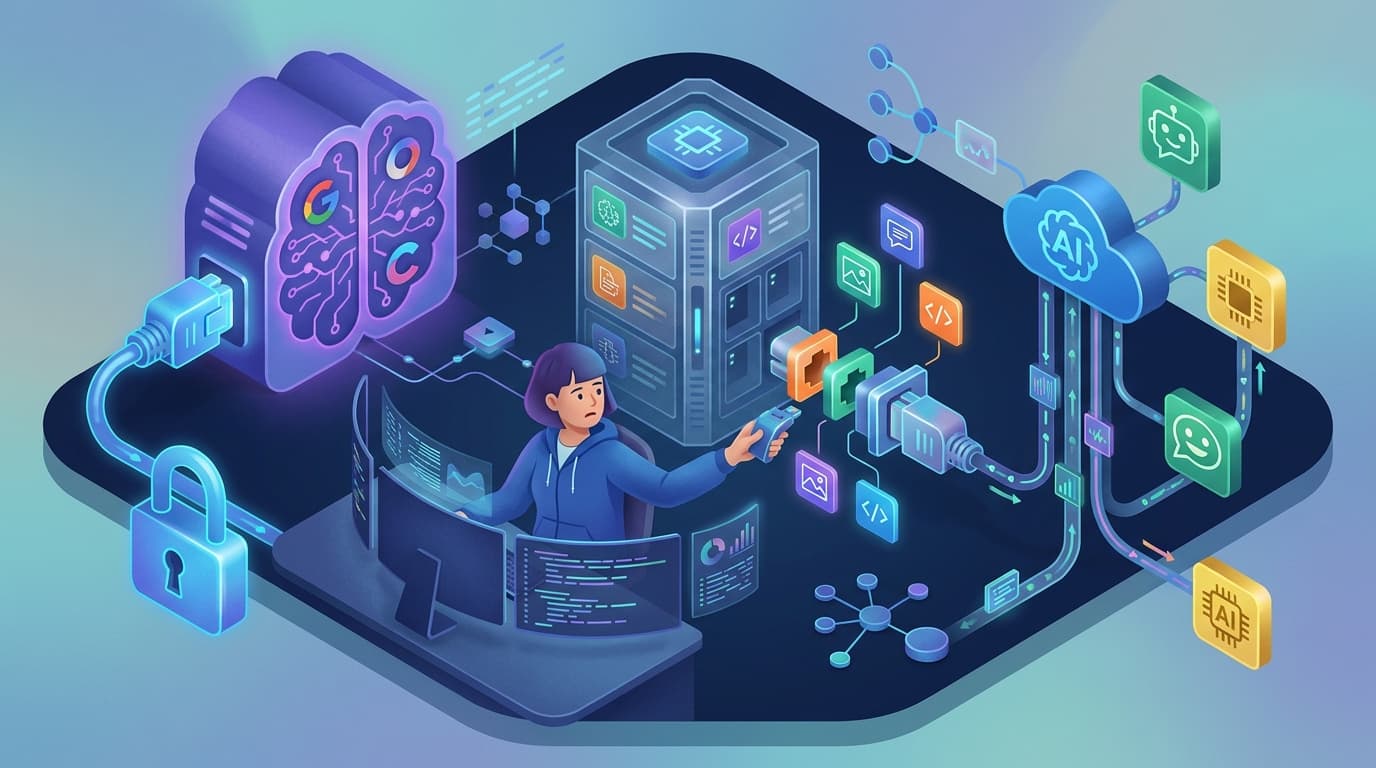
- Servers can run remotely. Early MCP servers ran as local processes on a developer's machine. Remote, hosted servers are now normal, which means a connector can live behind a proper URL, scale like any web service, and be shared across a whole team rather than reinstalled per laptop.
- Authentication grew up. Remote servers use standard authorization flows, so an agent connecting to your CRM or file store goes through the same kind of consent and token exchange you already trust for other integrations, rather than a raw API key pasted into a config.
- The vendors showed up. Major SaaS and infrastructure providers now ship official MCP servers for their own products. That is the strongest signal of all. When a vendor maintains the connector, you inherit their security posture and their update cadence instead of owning both yourself.
Put together, these changes turn MCP from a thing engineers wire up by hand into something closer to an app store for AI capabilities. That is the maturity leap that makes 2026 the year to take it seriously.
What the Ecosystem Actually Contains
It helps to picture the ecosystem as three concentric rings, because your strategy differs for each.
The core protocol and its tooling. This is the specification itself plus the SDKs and reference implementations that let any application act as an MCP client or server. It is stable, open, and vendor-neutral. You do not build here. You rely on it.
The public server catalog. Thousands of servers now exist for databases, file systems, project trackers, CRMs, payment platforms, analytics warehouses, and cloud providers. Quality varies. Some are official and enterprise-grade. Others are weekend projects with real security implications. This ring is where most of your day-to-day decisions live, which server to trust, which to fork, which to avoid.
Your custom servers. No catalog covers your proprietary billing engine, your internal data lake, or the domain-specific workflow that makes your business yours. These are the connectors you build and own. Done well, they are the highest-value part of your AI stack because they expose exactly the capabilities your competitors cannot buy off the shelf.
The skill in 2026 is knowing which ring a given need belongs to. Reaching for a custom build when a vetted official server exists wastes money. Trusting an unvetted community server with production credentials invites risk. Most mature teams end up with a mix: official servers for mainstream tools, a small number of carefully chosen community servers, and a handful of custom servers for what is genuinely unique. This build-versus-reuse judgement mirrors the wider decision we cover in build vs buy for custom AI.
The Security Question the Ecosystem Forces
An ecosystem this open raises an obvious concern. If any developer can publish a server, and your agent can install one and hand it credentials, what stops a bad connector from becoming a bad day?
This is the right question, and the ecosystem's answer is layered rather than magical.
- Provenance matters more than ever. Prefer official servers maintained by the vendor whose product they connect to. When you use a community server, treat it like any third-party dependency: check who maintains it, how active it is, and what permissions it requests.
- Scope credentials tightly. An MCP server should get the narrowest access that lets it do its job. A reporting agent needs read access, not write. A support agent needs one mailbox, not the whole domain. The protocol makes this easy to enforce because authorization lives on the server side.
- Log every tool call. Treat MCP servers as production services. Every action an agent takes through a server should be auditable, so you can answer "what did the agent do, and on whose behalf?" after the fact.
- Watch the prompt-injection surface. When an agent reads external content and then acts on tools, malicious content can try to hijack that action. Keeping human approval in the loop for high-consequence operations remains the practical safeguard.
None of this is unique to AI. It is the same discipline any business applies to third-party integrations and API access. What MCP does is make that discipline necessary at a new scale, because agents can now reach far more systems far more easily. For European businesses, this also intersects with data protection obligations, which we cover in our guide to GDPR-aware AI patterns.
What This Changes for a Business in Practice
The practical consequence of a mature ecosystem is speed, and a shift in where the real work sits.
Consider a professional services firm that wants an internal assistant able to answer questions across its project history. In 2024, that was a multi-month integration project. In 2026, the mainstream pieces, document storage, chat, project tracking, are official or well-maintained servers you connect in an afternoon. The engineering effort moves to the parts that are actually specific to the firm: how its proprietary knowledge is structured, which internal system holds the authoritative client record, and how access should be governed.
That reallocation is the real story. The ecosystem absorbs the commodity integration work so your budget concentrates on differentiation. A retail operation connects its warehouse and analytics through existing servers, then invests its custom engineering in the one workflow engine that reflects how it actually fulfils orders. A logistics company reuses connectors for its cloud and ticketing tools, then builds the custom server that exposes its routing system. In every case, the pattern from our MCP explainer holds: connecting existing tools to AI replaces building custom AI tools, and the ecosystem is what makes that replacement cheap.
There is a strategic dividend too. Because the ecosystem is model-neutral, the same servers work regardless of which LLM sits behind your agents. That keeps your options open as the model market moves, a flexibility we explore in choosing Claude, GPT, or open-source LLMs. Your integration investment does not get stranded when a better model ships.
A Practical Way to Plug In
For a business ready to adopt the MCP ecosystem rather than just watch it, a grounded sequence looks like this.
- Immediate: Inventory the tools your intended agents need to touch, and check the official registry for existing servers before assuming you must build anything. Most mainstream systems are already covered.
- Short-term: Stand up a small, governed pilot using official or vetted servers only. Scope credentials tightly, log every call, and pick one high-value workflow rather than boiling the ocean. Prove the pattern on something that matters.
- Ongoing: Identify the one or two systems that are genuinely unique to your business and invest custom server engineering there. Establish a simple policy for which servers are approved, how they are reviewed, and who owns them, the same governance you would apply to any production dependency.
The businesses that get value from MCP in 2026 are not the ones chasing every new server. They are the ones that treat the ecosystem as infrastructure: reuse aggressively where the catalog is strong, build deliberately where it is not, and govern the whole thing like the production system it has become.
The Ecosystem Is the Point
The most important thing to understand about MCP in 2026 is that the protocol was never the destination. The ecosystem was. A standard becomes valuable only when enough of the world adopts it that connecting things stops being a project and starts being a configuration choice. MCP has reached that point for the integration layer of business AI.
For your organisation, that means the barrier to putting AI to work inside real operations is lower than it has ever been, and it will keep falling as the catalog deepens. The advantage now goes to businesses that adopt the ecosystem thoughtfully: fast where reuse is safe, careful where credentials and custom logic are involved, and clear-eyed about the difference. If you want help mapping which of your systems to connect, which servers to trust, and which to build, our AI agent development team plans and operates MCP-based architectures for exactly this. The conversation usually starts on our contact page.