Payload CMS Explained: The Open-Source Backend for Modern Custom Apps
25 May 2026

For most of the last decade, building a custom application with content involved stitching together at least four things: a headless CMS for editorial content, a separate backend service for business logic, a database client layer, and a homemade admin panel for the parts the CMS could not handle. The result was usually expensive to build, harder to maintain, and locked into whichever vendor was holding the loudest part of the stack.
Payload takes a very different approach. It is an open-source, TypeScript-first headless CMS and backend framework that runs directly inside your Next.js application. One codebase, one deployment, one admin panel, and full ownership of the data. For the kind of custom platforms our clients tend to need, it has quietly become one of the most interesting options on the market.
In this article we will look at what Payload actually is, why it has been gaining traction with companies like Microsoft, ASICS, and Blue Origin, where it shines, and where you should reach for something else.
What Payload Actually Is
Payload is best described as a backend framework that ships with a content management system bolted on, rather than a CMS that pretends to be a backend. You define your data model in TypeScript, point it at a database (Postgres or MongoDB, and our guide to picking a database in 2026 explains why Postgres is usually the right side of that choice), and Payload gives you:
- A polished admin UI for editors, generated from your schema
- REST and GraphQL APIs for every collection
- Authentication, access control, and role permissions
- Localization, drafts, versioning, and publishing workflows
- File uploads, image processing, and digital asset management
- Hooks for custom business logic at every step of the lifecycle
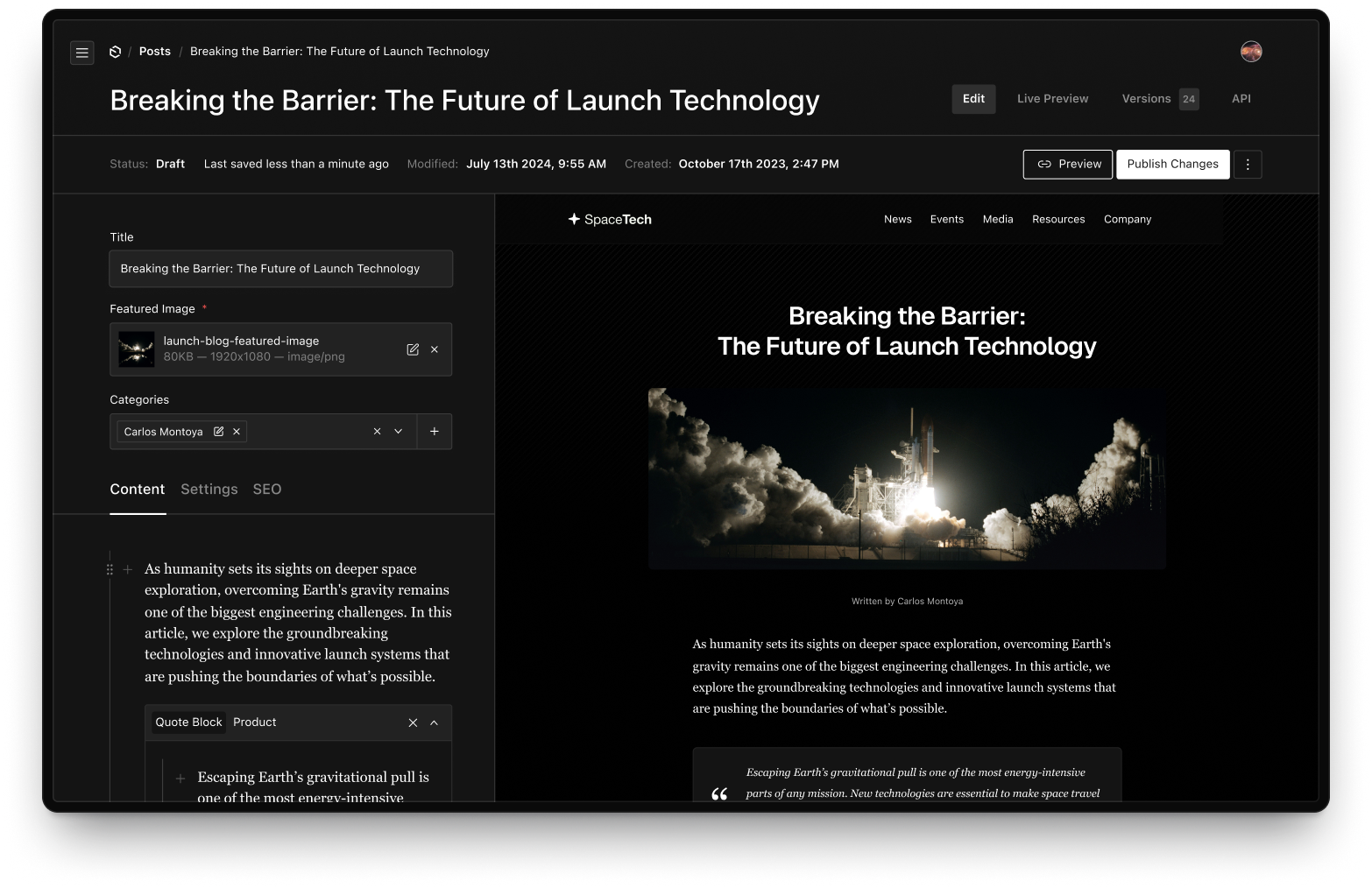
Critically, all of that lives inside the same Next.js app that serves your frontend. There is no separate API service to operate, no extra container to scale, and no proprietary cloud you have to be on. You can self-host on Hetzner, Coolify, AWS, Azure, or anywhere else that runs Node.
Payload's built-in authentication covers many projects out of the box, but if you need enterprise SSO, directory sync, or a hosted login experience, it is worth weighing a dedicated provider. Our comparison of Clerk, Auth0, WorkOS, and Supabase Auth walks through when each one earns its place.
If you have read our take on Convex as a reactive backend platform, Payload sits in a similar conceptual bucket: it tries to remove the seams between frontend and backend. The difference is that Payload is open source, self-hostable, and oriented around content-heavy applications rather than real-time apps.
Why Teams Are Choosing Payload
The pull toward Payload is rarely one feature. It is the way the trade-offs add up.
Ownership and no vendor lock-in. Payload is MIT-licensed open source. Your data lives in your database. Your code lives in your repository. If Payload disappeared tomorrow, your app would keep running. For companies who learned the hard way how expensive it is to migrate off a proprietary CMS, that alone is often the deciding factor. This is the same argument we make in our piece on open-source software, benefits and challenges.
One stack, one codebase. Marketing pages, product UI, admin panel, APIs, and background logic all live in the same Next.js project. New hires onboard once. Deployments ship one artifact. The boundary between "the website" and "the backend" essentially disappears.
TypeScript-first schemas. Collections, fields, and access rules are defined as TypeScript objects. That means full autocomplete, type safety end to end, and schemas that live in version control alongside the rest of the code. No clicking through an admin UI to define a content model that then drifts from production.
Production-grade out of the box. Auth, role-based access control, localization, drafts, versioning, and publishing workflows are not paid add-ons. They are part of the core. For teams that previously hand-rolled half of this, the time saved is significant.
EU-friendly hosting. Because Payload is just a Node app, you can run it on European infrastructure such as Hetzner or your own Kubernetes cluster, keep all data inside the EU, and stay clean on GDPR. No DPA gymnastics with a US-hosted vendor.
AI-ready architecture. Payload now ships features around vector embeddings and RAG-ready content, so plugging an AI assistant or semantic search on top of your own content is a configuration exercise rather than a months-long integration.
Where Payload Shines
Payload is at its best when the application is more than a marketing site but less than a sprawling microservices estate.
Custom platforms with both content and product. A typical fit is a SaaS or marketplace where the same team needs to publish marketing pages, manage editorial content, expose APIs to a customer-facing app, and run an internal admin panel. Payload handles all four without separate systems.
Multi-tenant SaaS. Access control, scoped queries, and per-tenant collections are first-class, which makes Payload a strong fit for B2B SaaS where every customer needs an isolated view of the data.
Headless commerce with bespoke needs. When off-the-shelf commerce platforms cannot model your catalog or order flow, Payload pairs well with a dedicated commerce engine. Compare that to a self-contained commerce platform like the one we wrote about in what is Medusa.js, and Payload sits one layer up: a flexible application backbone rather than a commerce-specific engine.
Internal tools and admin dashboards. Many of the wins we describe in our article on custom internal tools and operational ROI become much faster to ship when the underlying data layer already has a polished admin UI. Payload's admin panel is genuinely production-ready, not a developer-only afterthought.
Content-heavy apps with editorial workflows. Magazines, knowledge bases, partner portals, support hubs. Drafts, scheduled publishing, and multi-locale content are all built in.
When to Consider an Alternative
Payload is not the right answer for everything, and pretending otherwise leads to overbuilt projects.
- Pure static marketing site with no editorial team. A static site generator with Markdown in a repo is simpler and cheaper.
- A small content site whose owner just wants to log in and edit pages. A traditional CMS may have a smoother experience for non-technical users.
- A team already on a managed CMS like Contentful or Sanity with no real pain. Migration cost can outweigh the long-term ownership benefit.
- An MVP that is unlikely to outlive the next pivot. A simpler backend gets you to validation faster.
The honest answer is that for a meaningful slice of custom builds, particularly mid-sized SaaS and platform projects, Payload is the right starting point. The rest of the time, the simplest thing that works wins.
Getting Started Thoughtfully
If Payload looks like a fit, a few principles save a lot of pain later.
- Treat the data model as architecture. Spend real time on collections, fields, and relationships before writing the first page. Payload makes schema changes manageable, but rework still costs.
- Pick the right host early. Self-hosting on European infrastructure like Hetzner or Coolify is often the right call for EU clients, both for cost and for compliance. Choosing this up front keeps your CI/CD and observability aligned from day one.
- Use access control from day one. Role-based access in Payload is powerful and easy to misuse. Defining roles and scoped queries early prevents painful refactors later.
- Plan for editorial users, not just developers. The admin UI is great out of the box, but small customizations (custom field types, dashboards, named saved views) make a big difference to non-technical users.
- Bring in a partner who has shipped it. Payload is approachable, but the production version of any platform is where experience pays back. The same logic applies as in our guide to choosing the right software development partner.
The Bigger Picture
The interesting thing about Payload is not really Payload. It is the broader shift it represents. Custom application stacks are collapsing. The CMS, the API layer, the admin panel, and the frontend are no longer separate problems with separate vendors. They are one codebase, owned by you, deployed wherever you want, and shaped to your business rather than the other way around.
For European companies in particular, this matters. Owning the data, owning the deployment, and owning the code is no longer a luxury. It is increasingly a requirement, both for compliance reasons and for the simple fact that vendor pricing keeps creeping up year after year. Tools like Payload make that ownership genuinely practical.
If you are weighing whether a code-first headless backend is the right foundation for your next custom platform, our custom software team can help you map your requirements, pick the right stack, and ship a production-ready Payload application without the usual false starts.