A Tech Audit Checklist for Inherited Legacy Software
12 October 2026
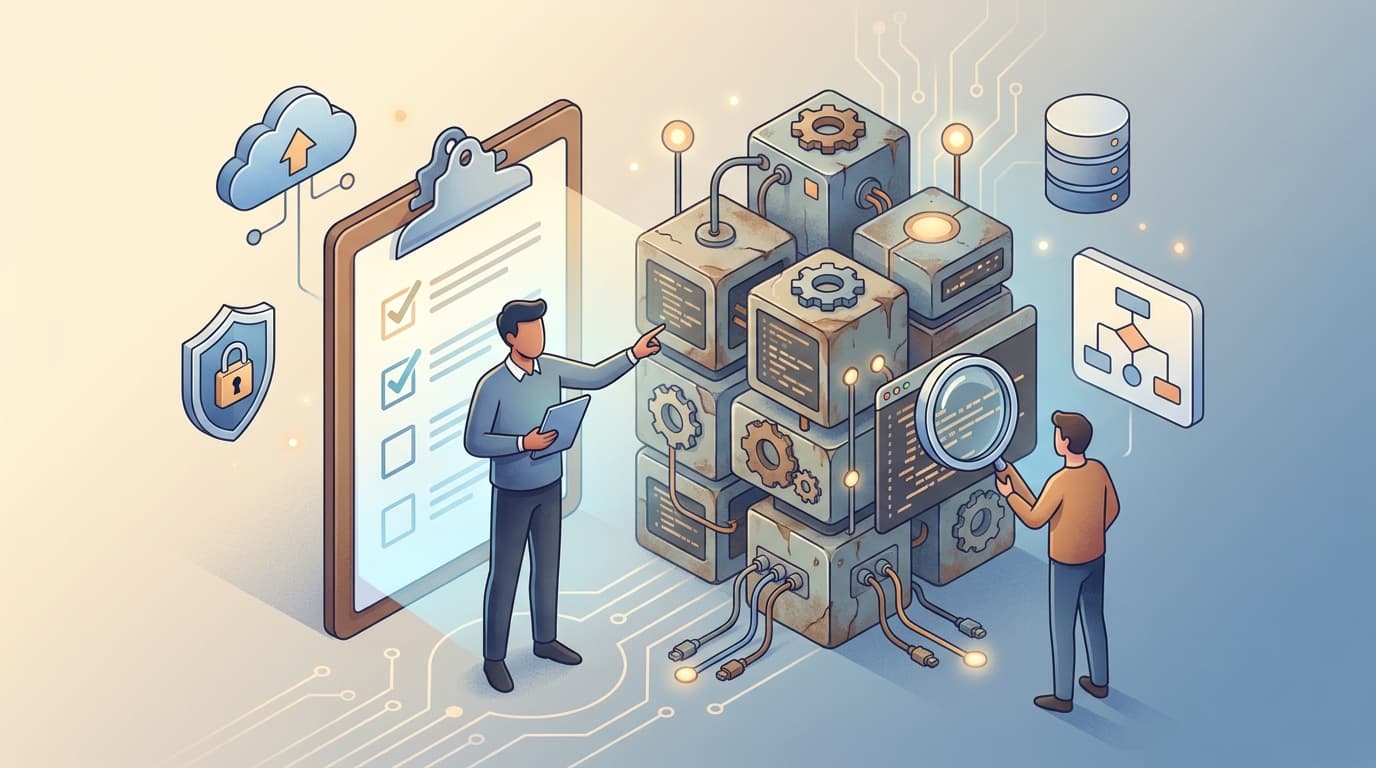
Inheriting a software product from a previous developer can feel like taking over a building without the plans. The application may still accept orders, manage customers, or support a core service, but nobody can confidently explain how all its parts work. That uncertainty makes even small changes expensive and turns routine maintenance into a risk decision.
A tech audit gives your business a factual starting point. It identifies what is reliable, what is vulnerable, and what deserves investment first. Rather than beginning with a rewrite, you can assess the system through the people who use it, the code and infrastructure that run it, and the business processes it supports. This checklist helps leaders turn an inherited platform into a practical modernization roadmap.
Why inherited software needs a structured audit
The biggest risk in inherited legacy software is not its age alone. It is the gap between what the business depends on and what the current team can verify. A platform can look stable while relying on one unmonitored server, an expired third-party account, or business rules buried in code that no one has documented.
Common warning signs include:
- No clear owner for domains, cloud accounts, source repositories, or app-store listings.
- Production changes made directly on live systems without review or rollback steps.
- Critical reports or integrations that only one former developer understood.
- Slow releases because the team cannot predict the impact of a change.
- Staff workarounds that hide usability problems or missing workflow capabilities.
An audit replaces assumptions with evidence. It also keeps the discussion user-centred: a feature that looks minor in the codebase may be essential to a finance, operations, or customer-support team. Before setting a budget, align the audit with the broader questions in how to choose the right software development partner so ownership, communication, and long-term support are part of the evaluation.
The inherited software audit checklist
1. Confirm access, ownership, and recovery paths
Start with control. Create an inventory of every account and asset required to run and change the product: source control, cloud hosting, domains, DNS, databases, email providers, analytics, payment services, app stores, and monitoring tools. Confirm that the business, not an individual supplier, holds administrator access and billing ownership.
Then test recovery. Document who can restore a database, rotate a credential, renew a certificate, and respond if a hosting account is unavailable. A password list is not a recovery plan. You need named owners, multi-factor authentication, secure credential storage, and a straightforward escalation route.
2. Map the business workflows before judging the code
Interview the people who use the software every day. Ask what they do before and after each screen, what they export to spreadsheets, which errors block work, and where customers abandon a process. This exposes the gap between the designed workflow and the real one.
Prioritise each workflow by revenue impact, operational risk, user volume, and regulatory sensitivity. The result is a concise map of what must keep working during change. It also gives your future solution a user-centred foundation instead of copying old screens into a newer framework.
3. Assess architecture, code health, and dependencies
A code review should answer business questions, not produce a score for its own sake. Identify the framework and runtime versions, the deployment path, test coverage, error handling, and whether the application can be built from a clean environment. List third-party packages and APIs, then flag unsupported components, single points of failure, and contracts that could change without warning.
Look closely at the boundary between systems. APIs, scheduled jobs, file imports, and manual handoffs often contain the most fragile logic. If a replacement is likely, a phased approach can preserve continuity while modules move one at a time. Our guide to migrating from a legacy system without breaking the business explains why this is usually safer than an all-at-once cutover.
4. Review data quality, privacy, and security controls
Inventory the data the system stores and where it travels. Include customer records, employee data, financial information, uploaded documents, logs, backups, and data held by connected vendors. Check retention rules, access permissions, encryption, audit trails, and how a person’s data can be corrected or removed when required.
Security review should cover more than a vulnerability scan. Confirm that dependencies are patched, privileged accounts are limited, backups can be restored, secrets are not embedded in code, and production access is logged. For EU businesses using AI features, data boundaries need equivalent care. These GDPR-aware AI patterns offer a useful reference when customer data may reach a model provider.
5. Measure performance, cost, and supportability
Collect evidence from real usage: uptime, page response times, failed jobs, support tickets, release frequency, cloud spend, and time spent on manual fixes. Pair this with feedback from users. A system that is technically available but makes staff repeat data entry is still creating an operational cost.
Classify findings into four decisions: keep and monitor, stabilise, improve, or replace. This avoids treating every imperfect component as a rewrite candidate. A robust, scalable platform is built by investing where business value and risk meet, then reviewing results as the organization grows.
A practical 30-day audit example
Consider a distributor that inherits an order portal built by a former agency. Its team reports occasional duplicate orders, warehouse staff maintain a parallel spreadsheet, and no one knows which API key connects the portal to the courier system.
In week one, the audit establishes account ownership, enables monitoring, and tests database recovery. In week two, workshops reveal that the spreadsheet is compensating for an order-status rule missing from the portal. In week three, the technical review finds an unsupported dependency and a nightly import that silently fails when a supplier file changes. In week four, the business has a sequenced plan:
- Stabilise the courier integration and add failure alerts immediately.
- Design the missing status workflow with warehouse users, then release it behind a tested rollback path.
- Replace the import with a documented API or validated upload flow.
- Plan the unsupported dependency upgrade alongside a broader platform roadmap.
This is not a speculative rewrite. It is a measurable programme that reduces disruption, improves daily work, and creates a foundation for growth. The same approach applies to membership platforms, booking systems, internal tools, and e-commerce operations.
Turn findings into an investment decision
Use the audit to agree on decisions at three horizons:
- This week: Secure ownership, backups, critical access, and the highest-risk credentials.
- This month: Validate the most important workflows with users, fix urgent reliability issues, and document integrations.
- This quarter: Fund a prioritized roadmap with clear outcomes such as fewer manual steps, faster release cycles, or improved customer completion rates.
For each initiative, name the business owner, technical owner, expected benefit, cost range in euros (€), dependencies, and success measure. This makes trade-offs visible. It also supports continuous improvement: support data and user feedback should update the roadmap after each release, rather than waiting for another crisis.
Conclusion
Inherited legacy software does not need to become a permanent source of uncertainty. A disciplined tech audit gives your team control of access, a clear view of user needs, evidence about technical risk, and a staged path to a more efficient operation. It protects what currently works while creating room for reliable, scalable improvements.
Novemind helps businesses assess inherited platforms and turn findings into practical delivery plans. If you need an independent view of an existing system, start the conversation.
Related reading: