Workflow Automation For Cyprus SMEs: A 2026 Playbook With AI Built In
28 May 2026

Most Cyprus SMEs we talk to in 2026 share the same problem. The team is small, the to-do list is long, and nobody wants to spend Friday afternoon copying invoice numbers from email into accounting software. Hiring is slow and expensive. Software is cheap. The math has changed.
What also changed is what automation can actually do. Five years ago, "workflow automation" meant Zapier connecting two SaaS apps with a rigid trigger. In 2026, it means a small team can route invoices, qualify leads, draft client emails, and reconcile accounts with a combination of node-based tools and AI agents that handle the messy edge cases. For a 5 to 50 person business in Nicosia, Limassol, or anywhere else on the island, that is a different conversation.
This article is a practical playbook. We will cover where automation actually pays off for Cyprus SMEs, the modern toolbox in 2026, five concrete automations you can ship in a quarter, and where AI changes the game versus where it just adds noise. The goal is to leave you with a clear sense of what to automate first and what to leave alone.
Why The Math Changed In 2026
A Cyprus SME today operates under specific pressure. EU compliance work has grown (GDPR, e-invoicing rules, the EU AI Act), tax and VAT processes have more steps than they did a decade ago, and clients expect SaaS-grade response times even from a 7-person team. At the same time, the talent pool is tight and salaries have climbed.
Workflow automation answers a specific question: what can we make the software do, so our people can focus on the work only people can do?
Common pain points we see across Cyprus SMEs:
- Invoices and receipts arriving in inboxes, getting forwarded to accounting, then manually entered (sometimes twice)
- Leads coming in from a website form, a WhatsApp number, and a Facebook page, with no single view of who replied
- Support requests via email, chat, and phone, triaged by whoever notices first
- Monthly reports rebuilt by hand from three different dashboards
- Onboarding documents for new clients living in someone's Outlook drafts
None of these are interesting problems. All of them eat hours. That is exactly the surface area where automation pays back fastest.
The 2026 Toolbox
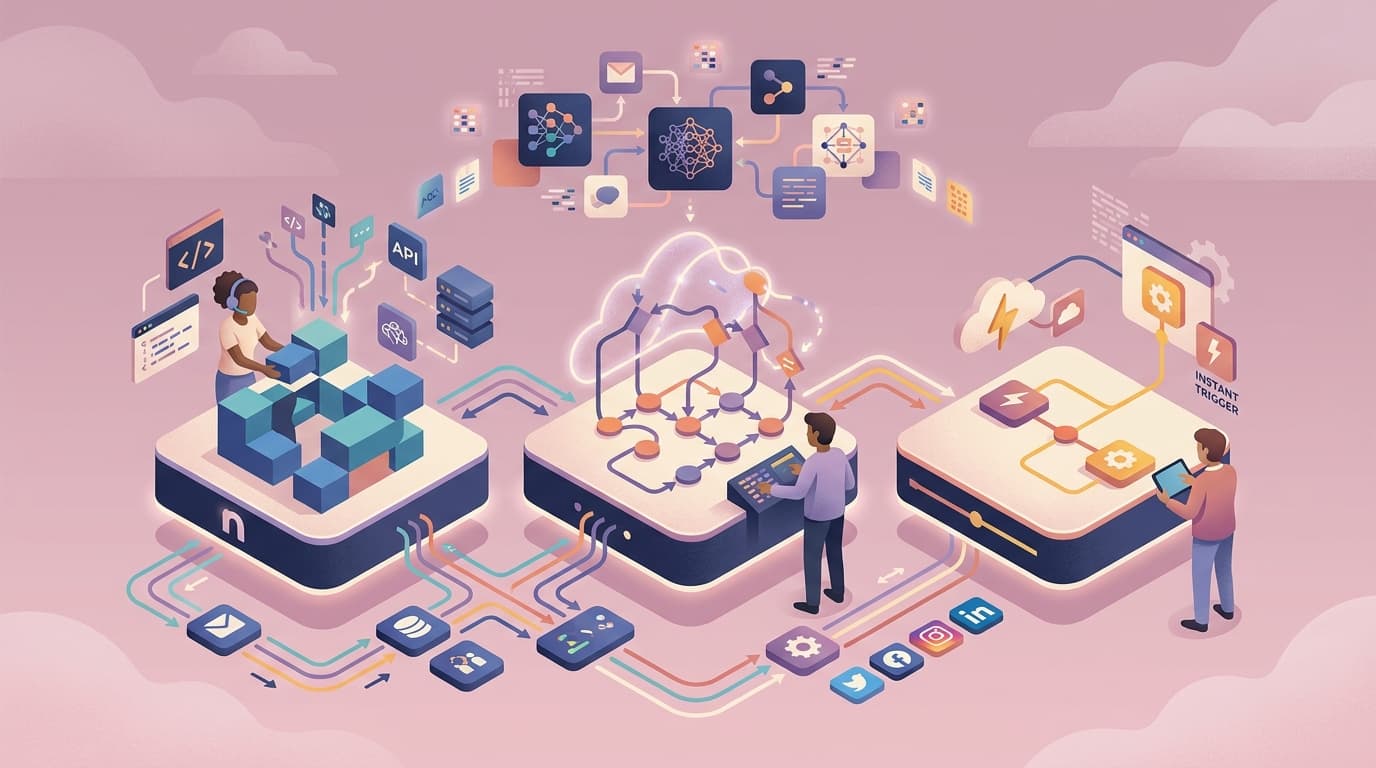
The automation landscape has three useful layers in 2026, and most SMEs will use a mix. The trick is knowing which layer fits which job.
Layer 1: No-code orchestration platforms
This is where most automations start. Tools like n8n, Make, and Zapier let you connect SaaS apps with a visual flow: "when an email arrives with an invoice attached, extract the data and post it to Xero." For Cyprus SMEs, n8n has a particular appeal because it can be self-hosted in the EU (or on your own server), which keeps client data inside the GDPR perimeter you already control.
These tools cover roughly 70% of useful automation work. They are cheap, fast to build, and easy to hand off to a non-developer for small tweaks.
Layer 2: Custom code where it matters
Some workflows hit the limits of no-code, usually when business logic gets specific or when an integration does not exist. A custom service (Node, Python, Go) running on a small VPS or in the same Docker stack you already use can handle the harder 20%: a bespoke pricing rule, a multi-step approval flow, a tight integration with a legacy system.
The combination matters more than the choice. A typical Cyprus SME stack in 2026 looks like n8n handling the routine glue, with one or two small custom services doing the proprietary work, all running on infrastructure the business actually owns.
Layer 3: AI agents for the messy 10%
The new layer in 2026 is LLM-powered agents. These are not magic, and they are not a replacement for the first two layers. They are useful for one specific class of problem: workflows that involve unstructured input or judgment.
Reading a PDF invoice from a supplier who never uses the same format twice. Classifying a support email as billing vs. technical vs. sales. Drafting a first-pass reply that the team only needs to review. Summarising a 40-minute client call into action items. These are the jobs where a deterministic rule fails and a human reads, judges, and types. An AI agent slotted into the workflow does the first pass, and a human approves.
We have written more on where agents fit in our guide to AI agents for small business.
Five Automations Worth Building First
These are the patterns we keep seeing pay back inside 90 days for Cyprus SMEs in services, e-commerce, and professional firms.
1. Invoice and receipt intake
The pattern: a shared inbox receives invoices from suppliers. An automation watches the inbox, extracts vendor, amount, VAT, and date from the attachment using an AI parser, posts the entry to your accounting tool, and files the PDF in cloud storage with a consistent name.
Why it works: invoice formats are unstructured but the fields are predictable. An LLM with a clean prompt and a JSON schema handles the variation. The deterministic part (post to accounting, file the PDF) is plain n8n.
Time saved: typically 4 to 8 hours per week for a small finance function. The bookkeeper now reviews entries instead of typing them. For a full walkthrough of this pipeline, including VAT handling and validation, see our guide on turning messy PDFs into clean accounting with AI invoice processing.
2. Lead intake and qualification
The pattern: leads come from a website form, an email address, and a WhatsApp number. All three feed into a single CRM record (HubSpot, Pipedrive, or a custom table). An AI step scores the lead based on company size, message content, and intent signals, then routes it to the right person with a draft reply attached.
Why it works: the slow step is not the routing, it is the triage. A small team without a sales operations person can give every lead a same-day response without anyone watching the inbox.
For Cyprus SMEs scaling this further, our piece on AI in modern CRM goes deeper on what changes when AI sits inside the customer engagement layer. Hospitality operators can apply the same connected-record pattern across direct bookings, restaurant service, and guest messages, as we cover in our guide to software for Cyprus hospitality businesses.
3. Support triage with first-draft replies
The pattern: support emails arrive in a shared inbox. An AI classifier tags each message (billing, technical, account change, general inquiry) and drafts a reply using your knowledge base as context. The team reviews, edits, and sends.
Why it works: the model does not need to be right 100% of the time, it needs to save the team typing. A team of two handling 30 to 80 tickets a day can cut handle time in half. We covered the underlying pattern in our explainer on RAG systems and how AI can actually use your company data.
4. Document and contract parsing
The pattern: client onboarding documents, service agreements, or supplier contracts arrive as PDFs or scans. An automation extracts key fields (parties, dates, amounts, renewal terms), pushes them into a structured table, and flags anything that needs legal review.
Why it works: contract work is high-stakes but the extraction step is low-stakes. Pulling renewal dates into a calendar so nobody misses a notice period is a quiet win that pays for the rest of the system on its own. If documents are the bulk of your workload, our deeper guide to document automation for service businesses walks through contracts, invoices, and claims in detail.
5. Reporting and weekly digests
The pattern: a scheduled workflow pulls metrics from accounting, the CRM, web analytics, and any operational system, then composes a one-page summary every Monday morning. An LLM step writes the narrative ("revenue is up 8% week-over-week, driven by three deals closing in services"), and the structured numbers sit underneath.
Why it works: most management reports take 2 to 3 hours to assemble and 10 minutes to read. Flipping that ratio is a clear win, and the LLM-written commentary actually gets read.
Where AI Changes The Game, And Where It Doesn't
A useful test in 2026: if your automation step can be written as "if X then Y" with no judgment involved, do not use an LLM. Plain n8n or code is faster, cheaper, more reliable, and easier to debug.
AI earns its place when the input is unstructured (free-text email, varied PDF formats, voice notes), when classification or extraction is needed, or when the next step is a human reviewing a draft. The agent does the first pass, the human approves. That is the pattern that scales.
What goes wrong: teams sometimes try to use an LLM as the orchestration layer itself, asking it to "handle the whole workflow." This is slower, more expensive, and harder to audit than a normal flow with one or two AI steps inside it. Keep the LLM scoped to one job at a time.
For Cyprus SMEs concerned about data residency, the choice of model also matters. We covered this in choosing Claude, GPT, or open source LLMs for European businesses in 2026, including options for keeping inference inside the EU.
Pitfalls Worth Naming
A few things consistently sink automation projects:
- Automating broken processes. If your invoice workflow has three approvers and two of them never look, automating it just makes the broken version faster. Map the process first, fix the obvious problems, then automate.
- No owner. Workflows drift. APIs change, vendors update formats, edge cases multiply. An automation with no owner becomes shelfware in 6 months.
- Building everything in one tool. Cramming custom logic into a no-code platform makes it brittle. Cramming simple glue into custom code makes it slow to change. Use each layer for what it is good at.
- Skipping the review step on AI outputs. For anything client-facing or financially material, keep a human in the loop until you have months of clean data on the model's accuracy. Trust is earned slowly.
How To Start: A 90-Day Plan
For a Cyprus SME ready to start, the path is short.
Weeks 1 to 2: Pick the single workflow that costs the most time today. Write down every step. Identify what is deterministic, what needs judgment, and what the team would actually trust to a machine.
Weeks 3 to 6: Build the first automation in n8n (or Make, or Zapier) with one AI step if needed. Keep humans in the approval loop. Measure time saved against a baseline.
Weeks 7 to 12: Pick the second workflow. Reuse what you learned. By the end of the quarter, you should have two or three live automations, a clear sense of which patterns work in your specific business, and a named maintenance owner.
After that, the question shifts from "should we automate?" to "what is next on the list?" That is the goal.
The Bigger Picture
Workflow automation in 2026 is not a technology project, it is an operations project with technology inside. The Cyprus SMEs getting the most out of it treat their automations like internal products: they have an owner, they get reviewed, they evolve as the business does. The tools are commodity, the business value comes from the discipline of running them well.
We help Cyprus businesses do exactly that, from picking the first workflow to designing AI-augmented processes that scale with the team. If you want to talk through where automation pays off in your business, start the conversation or explore our work on AI agent development and custom software solutions.
Related reading: