AI Lead Qualification: Stop Wasting Sales Time on Cold Inbound
5 September 2026
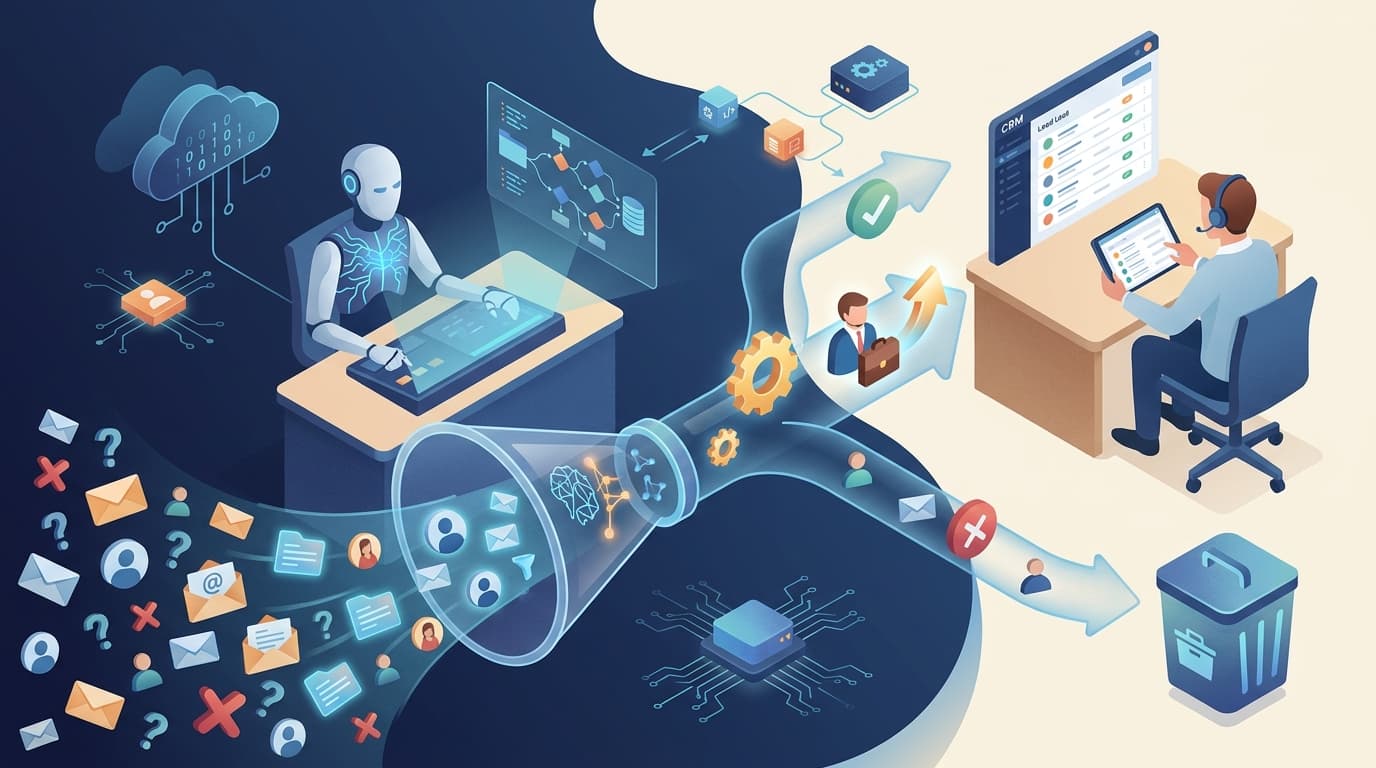
A sales inbox can look busy while the pipeline remains thin. A contact form asks for a quote with no company name. A generic agency enquiry arrives from an address that never replies. Meanwhile, the prospect with an active project waits until the next morning because the team is working through messages in order. AI lead qualification helps correct that mismatch by sorting incoming demand according to evidence, not inbox timing.
The goal is not to let a model decide who deserves respect. It is to give every inbound enquiry a consistent first pass, preserve the context a salesperson needs, and route genuine opportunities quickly. Done well, the process improves the buyer experience, reduces repetitive administration, and makes the sales team more effective. This guide explains where AI fits, how to keep humans in control, and how to measure whether the system is earning its place.
Why manual lead handling breaks as volume grows
Most smaller teams start with a workable routine. Someone checks forms, email, LinkedIn messages, and referrals, then copies useful details into a CRM. The process becomes fragile once several channels and more than a handful of enquiries arrive each day.
Common symptoms include:
- Leads waiting because nobody owns the first response
- Salespeople spending time researching companies that have no plausible fit
- The same qualification questions being asked repeatedly
- Good context disappearing during copy-and-paste handovers
- Marketing reporting on lead volume while sales cannot see lead quality
A conventional rule-based workflow can route a form based on country or service selection, but it struggles with messy inputs. A message such as “we need something like Uber for inspections, what would it cost?” contains useful signals about urgency, use case, likely scope, and uncertainty. An AI step can extract those signals into structured fields while a deterministic workflow handles routing and record creation.
That division matters. AI should interpret unstructured text, not become an unaccountable sales manager. The wider pattern is the same one used in workflow automation for Cyprus SMEs: use reliable automation for known steps and reserve AI for ambiguity.
A practical AI lead qualification system
A useful system has four layers: capture, enrichment, scoring, and human action. Each layer should be visible to the people who use it.
Capture the full enquiry once
Start by bringing website forms, shared inboxes, chat, and referral submissions into a single intake. Store the original message, source, timestamp, consent status, and any form answers. Avoid asking an AI model to infer information you already collected.
A CRM record should also keep the model’s extracted fields separate from the original source. That makes later corrections possible and gives your team an audit trail. If the business already has customer and prospect data across several systems, the same connected-data discipline discussed in AI in modern CRM becomes essential.
Enrich only where it changes a decision
Enrichment can include company website, industry, company size, geography, existing technology, and prior conversations. It is tempting to collect everything. It is more useful to collect only what supports a real routing or follow-up decision.
For a custom software company, high-value signals often include:
- A defined operational problem rather than a request for a generic price
- A named decision-maker or a clear buying team
- A credible deadline, event, or growth trigger
- An existing system that needs integration or replacement
- A realistic indication of project scope or procurement process
Public company information can fill gaps, but it must never be treated as certainty. The system should show the evidence it used and label missing data as missing. This protects user-centric communication because the salesperson can ask a useful question instead of pretending to know the buyer’s situation.
Score fit and intent separately
A single “hot” label hides too much. Fit asks whether the organisation and problem match the service you provide. Intent asks whether the person is actively trying to solve it now. A small company with an immediate, well-defined integration problem can be more valuable than a large company that is simply researching ideas.
Use a simple, explainable score. For example, a workflow can score 0 to 100 across fit, intent, completeness, and risk. The AI supplies a short rationale with citations to the enquiry text. It does not invent budget or authority. Any high-value lead that includes uncertainty should be routed to a human review queue rather than silently rejected.
This approach complements, rather than replaces, the work of AI agents for small business. An agent can draft the next step and update a CRM, but the commercial relationship remains human-led.
Give people an action, not another dashboard
The output must make the next action obvious. A high-intent lead can receive a prompt acknowledgement and be assigned to a salesperson with a concise brief. A medium-fit lead may enter a short discovery sequence. A low-fit or incomplete enquiry should receive a respectful response that asks one or two clarifying questions, not an automated dead end.
A strong handover brief includes the original message, extracted problem, suggested service, score rationale, unresolved questions, and recommended owner. That turns AI into operational efficiency, not another tab to monitor.
A realistic implementation example
Imagine a Cyprus-based services business receiving 80 enquiries a month across its website and email. Before automation, two people spend roughly 10 minutes per enquiry reading messages, researching companies, assigning owners, and entering notes. That is more than 13 hours each month before meaningful sales work begins.
A first version can use a form or inbox trigger, a CRM, an enrichment provider where appropriate, and an LLM with a strict JSON schema. The model extracts service interest, stated problem, urgency, estimated complexity band, and questions to ask next. A workflow then applies routing rules and creates tasks. Human review is required for any rejection, sensitive industry, or score near the handoff threshold.
The first metric is not conversion rate. It is completeness and accuracy: can a salesperson trust the brief without reopening every source? Then measure median first-response time, percentage of qualified meetings, and hours spent on administration. Once those are stable, compare opportunity creation and revenue outcomes by source and score band.
Cost control matters. Keep prompts short, cache stable enrichment, and do not run models over old records without a reason. Our guide to the real cost of running an AI agent explains why usage, monitoring, and maintenance belong in the business case from day one.
Controls that protect prospects and your team
Lead qualification touches personal data and commercial decisions, so it needs guardrails.
- Keep a human decision-maker. Do not automatically reject a person solely from an AI score.
- Minimise data. Process only information needed for a legitimate sales workflow and define retention periods.
- Test for bias. Review outcomes across sectors, languages, regions, and company sizes. A score should reflect buying signals, not proxies for who seems familiar.
- Make escalation easy. Let salespeople correct a score and record why. Those corrections become the best evaluation data.
- Measure model quality. Sample decisions regularly and compare recommendations with later outcomes. Our guide to AI evaluation outlines how to turn those samples into a dependable test set.
These practices create a robust system that can improve as the business changes. More importantly, they preserve trust with both buyers and the people accountable for revenue.
A 30-day starting plan
Begin narrowly. In week one, map the current path from first enquiry to first sales action and agree what “qualified” means. In week two, collect 30 to 50 historic enquiries and have salespeople label the information they actually needed. In week three, build a shadow workflow that produces recommendations without changing routing. In week four, review accuracy, revise the rubric, and automate only the safe handoffs.
The decision framework is straightforward. If the inbound volume is low and every enquiry already receives thoughtful attention, start with better CRM hygiene. If volume, channel fragmentation, or slow response is costing opportunities, AI qualification can create a meaningful advantage. The best solution is designed around your real sales process, not a vendor’s generic score.
AI lead qualification should make the sales team more available for conversations that need judgment, empathy, and expertise. At Novemind, we build AI agent development solutions and connected operational systems that keep people in control while removing repetitive work. If you want to assess your current inbound process, contact our team.
Related reading: