Software for Cyprus Hospitality: POS, Bookings, and AI Concierge
24 August 2026
A guest asks WhatsApp whether late check-in is possible. Another books a table through a social profile. At reception, a family wants local recommendations while the restaurant team is trying to reconcile walk-ins with the point-of-sale system. In too many Cyprus hospitality businesses, each moment lands in a different inbox, app, spreadsheet, or staff member’s memory.
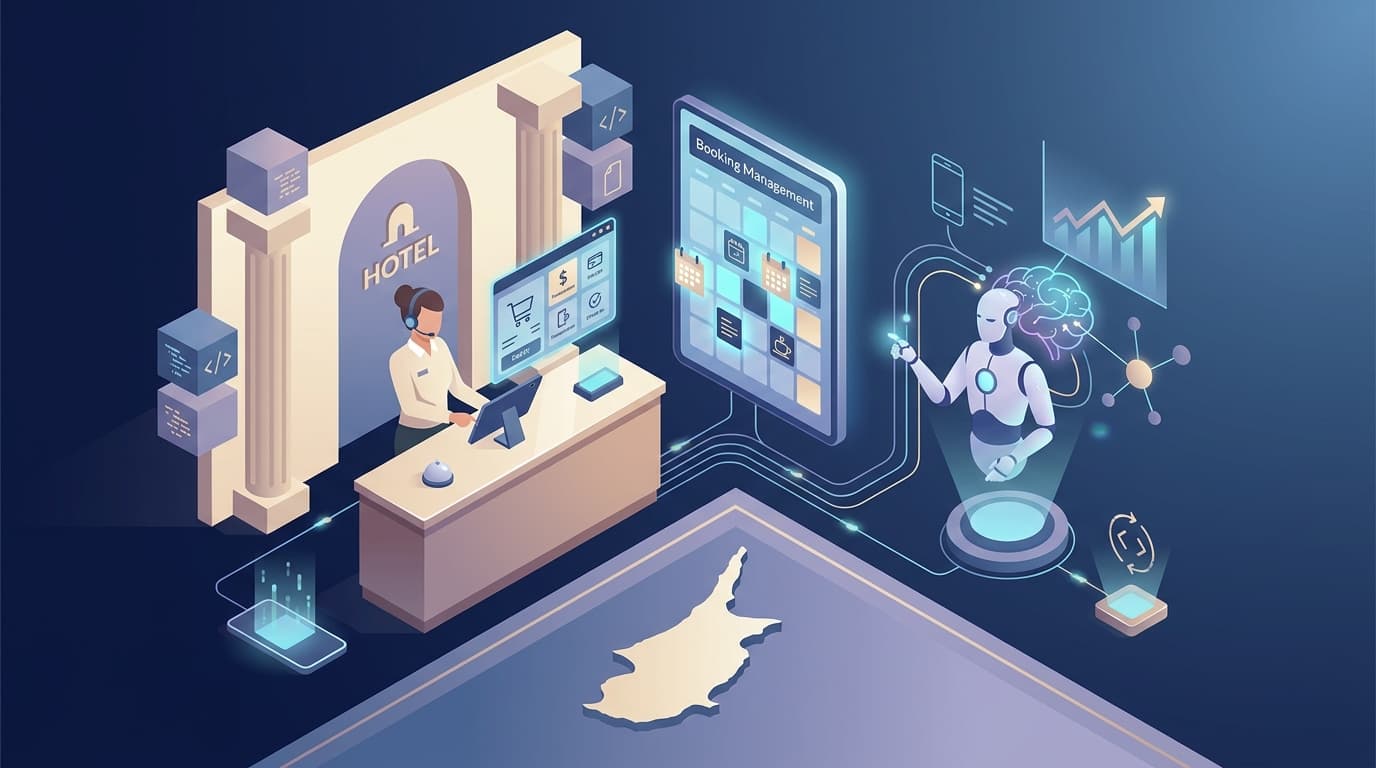
Hospitality software should make that work feel joined up. The goal is not to replace the warmth that makes a guest stay memorable. It is to give people the right information at the right moment, remove repetitive admin, and create a reliable view of operations. This guide sets out how POS, bookings, guest communications, and an AI concierge can work together for hotels, restaurants, villas, and activity providers across Cyprus.
The Problem Is Fragmentation, Not a Lack of Apps
Most operators already use software. The issue is that the systems do not share the context staff need. A property-management system may know a guest’s arrival date, the restaurant POS may know what they ordered, and a booking tool may know their party size. None of that helps if the front desk must manually look in three places before responding.
Common signs of fragmentation include:
- Reservations arrive through website forms, online travel agencies, phone calls, and messaging apps.
- The POS, inventory tool, and accounting package require duplicate entry.
- Guests repeat the same request to several members of staff.
- Managers receive reports days after a busy weekend, not while decisions still matter.
- Seasonal staff need long training because the process lives in people rather than software.
The cost is more than wasted minutes. Missed handovers affect guest satisfaction, duplicate records distort reporting, and a slow reply can turn an enquiry into a booking elsewhere. The right response is a user-centric operating design, starting with the journeys of guests and staff rather than a shopping list of products.
The Connected Hospitality Stack
A scalable hospitality platform does not need to be a single giant system. It needs clear ownership of data and dependable connections between the systems that matter.
A booking and guest record at the centre
Start with one guest record that links reservations, communications, consent, preferences, and service requests. A hotel may retain its property-management system while using a custom integration layer to connect direct bookings, dining, activities, and customer relationship management.
The central record should answer practical questions quickly: who is arriving today, what have they booked, which requests are open, and what does the team need to know to serve them well? GDPR-aware access controls are essential. A restaurant host does not need access to every detail held by the property manager, and every integration should use only the data needed for its job.
POS that informs service, not just finance
A modern POS should record sales accurately, but its operational value is greater when it updates stock, promotions, guest accounts, and reporting without manual re-entry. For a resort, a restaurant charge can be linked to the room or guest record. For a beach club, staffing and stock decisions can respond to live covers and sales rather than yesterday’s spreadsheet.
Where an off-the-shelf POS is a good fit, keep it. Custom development is most valuable at the seams: local tax workflows, a bespoke loyalty experience, or integration with the way your operation actually handles packages and activities. This same principle is central to designing software around how your team actually works.
Automation for predictable handovers
The reliable, repetitive work belongs in workflows. A booking confirmation can create the guest record, notify the appropriate team, schedule a pre-arrival message, and flag dietary or accessibility requests. A cancellation can release availability and trigger a waitlist message. A completed stay can request feedback at the right time.
These are not glamorous automations, but they create measurable operational efficiency. The workflow automation playbook for Cyprus SMEs explains how to identify similar high-return processes and assign a maintenance owner.
An AI concierge for the unstructured questions
An AI concierge earns its place when it handles natural-language questions that staff repeatedly answer: check-in instructions, opening times, facilities, local transport, or how to book an experience. It can operate on web chat, messaging, and a guest app, while handing complex or sensitive requests to a person.
The guardrail is simple: the concierge should retrieve approved, current information from your knowledge base and booking systems. It should not invent availability, prices, policies, or local recommendations. For a strong technical foundation, use the patterns in RAG systems for company data, including source grounding, permissions, and evaluation.
What This Looks Like in Practice
Consider a 60-room boutique hotel with a restaurant and local excursions. Before integration, the reservations team checks several channels, the restaurant receives a daily printed guest list, and concierge requests live in email threads. Staff are helpful, but handovers depend on who is on shift.
A phased project starts by connecting direct bookings and the property-management system to a shared guest timeline. Next, it adds automated pre-arrival messages that invite guests to reserve a table or excursion. The restaurant receives live, permission-appropriate information on expected covers, while the operations manager sees a simple dashboard of arrivals, requests, and bookings.
Finally, an AI concierge answers approved pre-arrival questions in English and Greek, offers handoff to a member of staff, and records unresolved questions for the knowledge-base owner. A guest still gets a human response when the request needs judgement. The team simply spends less time copying data and more time creating a good stay.
This approach works across the sector:
- Villa managers can coordinate arrivals, maintenance, and local services from one workflow.
- Restaurants can combine booking, waitlist, and guest preference data without forcing staff into a complex back office.
- Tour operators can automate confirmations and document collection while retaining human support for itinerary changes.
- Multi-site groups can standardise reporting and brand experience while allowing each venue its own operating details.
The business value comes from robust connections and continuous support, not from adding AI for its own sake.
A 90-Day Implementation Plan
A focused rollout is safer than a wholesale replacement.
First 30 days: map a guest journey from enquiry to follow-up. List each system, manual handover, and data owner. Choose one measurable target, such as first-response time, duplicate entry, or table upsell rate.
Days 31 to 60: connect the highest-value sources and build one workflow that staff can observe. Train a small group, collect exceptions, and make sure reporting reflects the real operation. Keep humans in the approval loop for financial changes and guest commitments.
Days 61 to 90: add a second workflow or a tightly scoped concierge pilot. Review guest feedback, staff adoption, data quality, and savings. Use the result to decide whether to extend the platform, not to assume success from a demo.
When selecting a partner, look for hospitality understanding, integration capability, and a commitment to maintain the solution after launch. Our guide to choosing the right software development partner offers practical questions to ask before you commit.
Conclusion
Connected hospitality software helps Cyprus businesses deliver the personal service guests value while giving teams a calmer, more reliable way to operate. A shared guest record, integrated POS and bookings, focused automation, and a grounded AI concierge can reduce admin, improve response times, and support growth through busy seasons.
The winning implementation is not the one with the most tools. It is the one built around genuine guest and staff needs, with scalable architecture, clear data governance, and a partner who stays involved as the operation evolves.
If you are ready to map the most valuable connections in your hospitality operation, talk to Novemind. Together, we can turn disconnected touchpoints into a service experience your team can run confidently.
Related reading: